
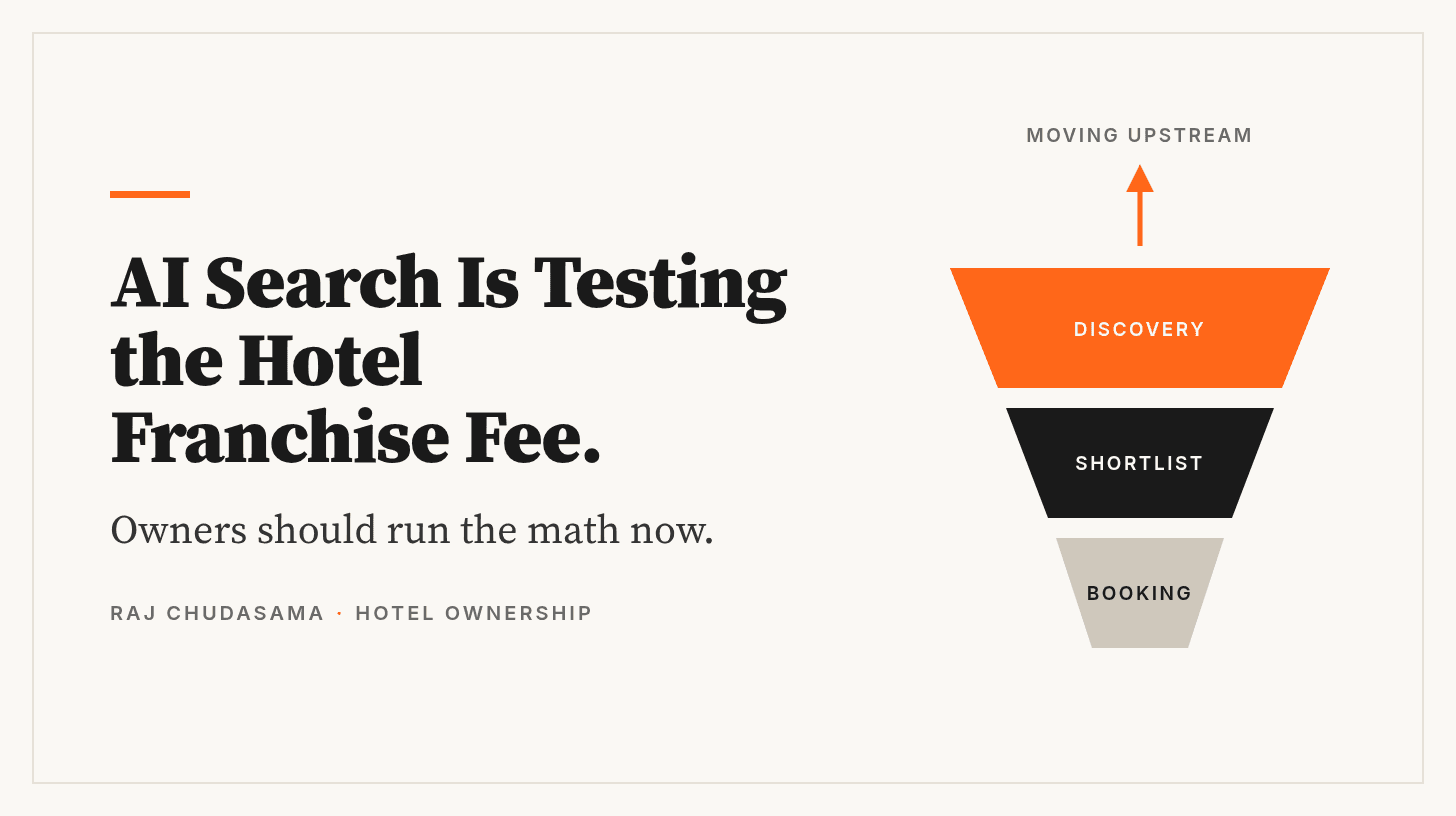
More than half of active U.S. travelers, 56%, used AI for at least one trip in the past 12 months, up from 33% in the first half of 2025, according to Phocuswright. The booking side looks very different. In August, Booking Holdings' CFO told analysts that traffic from large language models is still significantly below 1% of the company's room nights. Discovery is moving to AI search much faster than booking is, and that gap is where the next round of franchise fee conversations is going to happen.
It's already on the record. At the Lodging Conference in Phoenix this month, Aimbridge CEO Craig Smith put it plainly:
"One of the big reasons folks sign up with brands is for distribution. How many room nights will you give me at what price? That is going to change."
He added that when he asked AI consultants whether brands or OTAs come out ahead, the answers split 50/50. On a separate panel, Sonesta co-CEO Keith Pierce called AI "probably the biggest distribution disruptor since the OTAs."
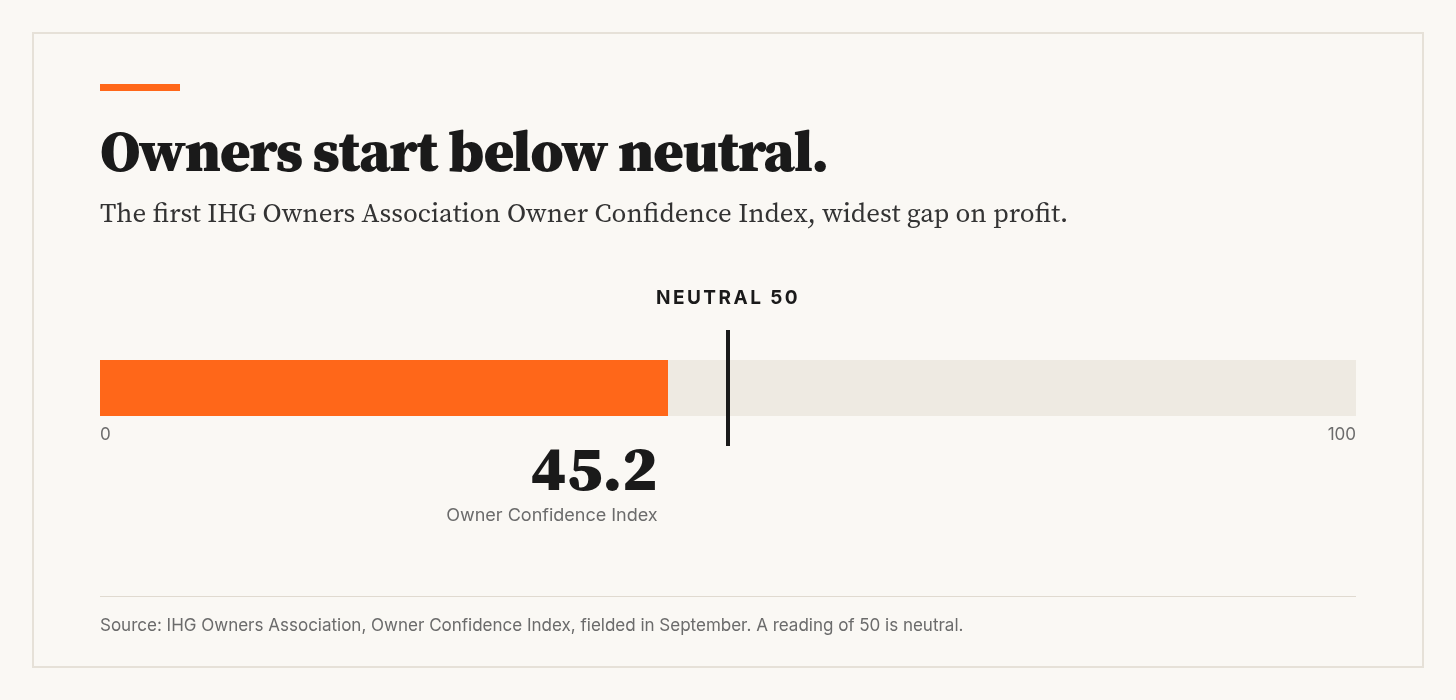
Owners are walking into that conversation in a soft mood. The IHG Owners Association's first Owner Confidence Index, fielded in September, came in at 45.2, below the neutral mark of 50, and the gap was widest on profit.
What owners buy from a brand
Strip it down and the fee buys distribution, loyalty and purchasing power. The franchisor carries the brand. The owner carries everything else, from labor and insurance to the next PIP. Add up royalties, marketing and loyalty fees, reservation charges and the required tech, and the total cost of a flag often lands somewhere around 13% to 17% of room revenue.
The panel didn't pretend brands bring nothing. Brookfield's Shai Zelering said brand value is "diminishing," but he also said brands still have real purchasing power in how they negotiate with IT systems, OTAs and vendors. Apple Hospitality REIT's Justin Knight said brands have shown a willingness, through fee concessions and other incentives, to invest alongside owners. Both points hold up.
The same math applies whether the flag sits under Marriott Bonvoy, Hilton Honors, IHG One Rewards, World of Hyatt, Wyndham Rewards, Choice Privileges or Accor ALL. Loyalty and distribution are the core of what owners pay for, and distribution is the part AI is touching first.
How fast AI is changing hotel booking
Faster on discovery than on the transaction. Phocuswright found that half of travelers who use AI in search engines still click through to source websites after seeing the AI answer.
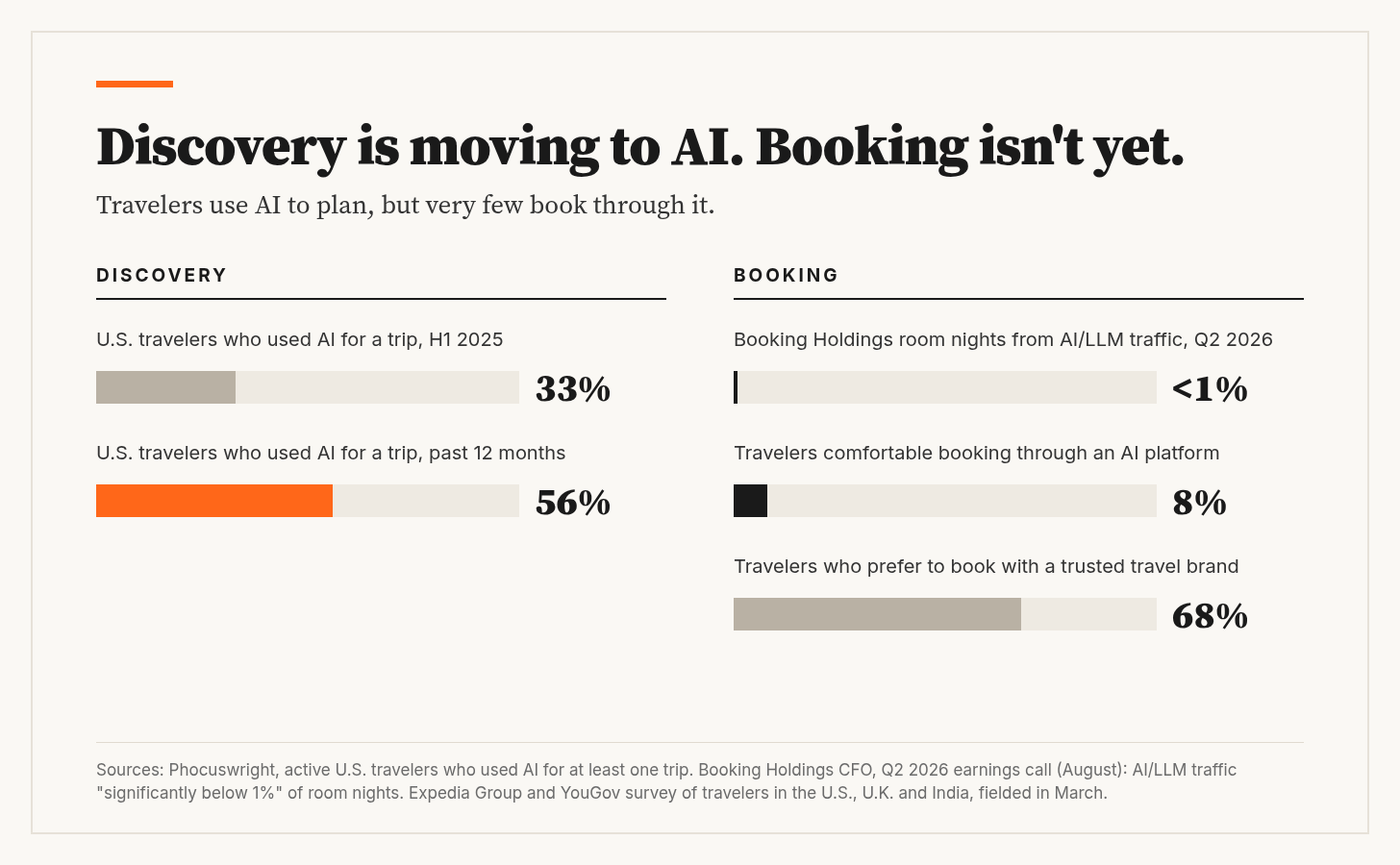
Expedia Group's survey with YouGov, fielded in March across the U.S., U.K. and India, found that 68% of travelers would rather book with a trusted travel brand than with an AI chatbot or agent. Only 8% said they're comfortable booking through an AI platform. In that survey, "trusted travel brand" includes the OTAs, so the hotel brands aren't the only ones counting on that trust.
Read fairly, brands and their loyalty programs still own the transaction today. What's moving is the shortlist. It's forming upstream, inside an assistant the brand doesn't control, before anyone opens a brand app.
The blind spot is real for everyone. On that same August call, Booking's CEO Glenn Fogel was asked whether travelers go from an AI answer straight to the hotel. His answer: "I don't know. They don't tell me." If the largest OTA can't see that path, most owners probably can't either.
Smith expects leisure to move first, with business travelers staying with brands longer because of loyalty. That tracks. Points are the strongest reason a frequent traveler books direct with a flag, and frequent travelers are the last ones a brand wants to lose.
Who owns the guest data when AI is the front door
If an AI assistant builds the shortlist from structured property data, reviews and the property's own web presence, the owner's data and content start to matter more. The owner is the one who knows the property best, and in an AI answer, the details that win are usually property details.
In my experience, a lot of the guest data, the email and the booking history sit on brand systems rather than with the owner. Earlier this month I tried connecting an AI assistant to the Outlook account at one of our franchised hotels. What came back was an access request that expires in 30 days. Caution with business data is fair. It's also how operators end up running on tools someone else picked.
Brands carry real risk if guest data leaks, and that caution protects owners too. The cost shows up when the front door moves and the owner can't see who's walking through it or why.
Direct booking is the floor, AI discoverability is the ceiling. Both depend on the owner having accurate content and usable data, wherever the booking ends up.
What to ask for at renewal
The franchise model can stay. What needs to change is how owners and brands measure what the fee buys now that discovery is moving, and a few asks are fair to put on the table:
- Report loyalty contribution and AI-referred bookings by property, so owners can see what the system delivers at their hotel.
- Share guest and booking data with the operator who's actually serving the guest.
- Tie part of the fee to measured distribution performance.
- Publish the brand's AI search plan, including what it'll cost the property.
Highgate's Dina Winder said it well at the same conference: "The business models are different, but the goals are the same." Brands that can prove distribution value in AI search keep their pipeline and their renewals. Owners get a fee they can defend to their investors and lenders. That's a fair trade for both sides.
Operator takeaway
- Know your loyalty contribution and your OTA mix by property.
- Ask your brand for AI-referral reporting now, before renewal.
- Make sure your property's own content and data are accurate where AI assistants read them: your website, your listings and your reviews.
- Model the total cost of flag against a well-run independent with a modern tech stack.
The booking still runs through the brand. The question is how long the fee can rest on that.
Raj Chudasama is an owner-operator with Kriya Hotels. This post first appeared on his Substack, where he writes about hotel ownership, distribution and technology. More about Raj.